The STEREO Map
From Autopilot to Awareness
And From Awareness to Choice

Every situation triggers a process in your mind
It happens fast, often automatically,
and most of the time, you’re not aware of it.
The STEREO Map makes that process visible.
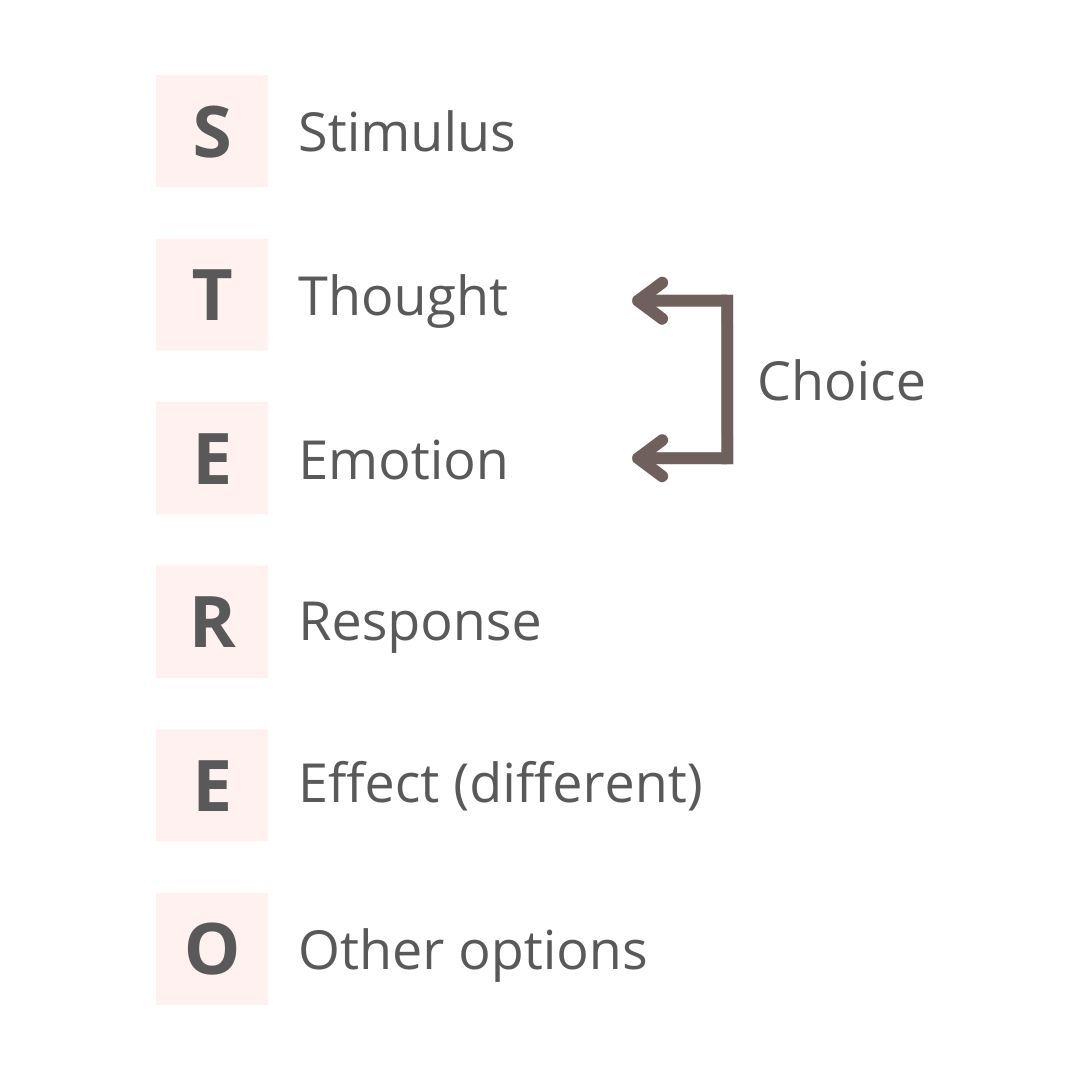
The STEREO Map
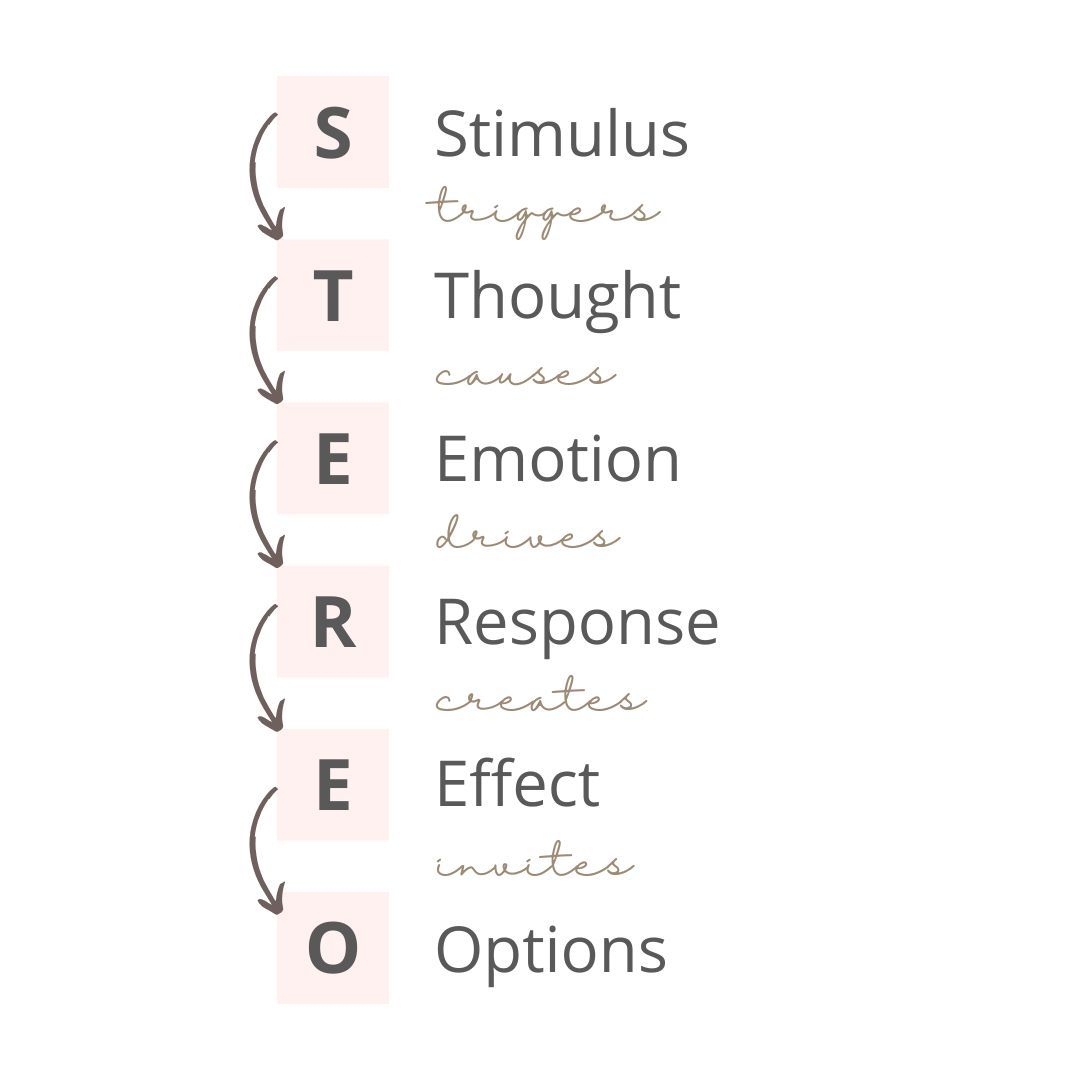
This is what happens in every situation:
S timulus — the situation
T hought — what you think about the situation
E motion — how you feel
R esponse — what you do
E ffect — the effect of what you think-feel-do
O ptions — other perspectives
Most of the time we run our think-feel-do patterns on autopilot.
Because of positive-negative-asymmetry of the brain, most people focus on one interpretation:
- "that's wrong"
- "this is bad"
And that negative outlook is not always useful and it can keep you stuck.
The "O" will help you open up to other perspectives.
Not by replacing your negative thought, but by adding new ones that are also true.
Here's an example:
S — Stimulus
What happens factually seen. A situation, event, or trigger.
For example: A student said "I didn't do my homework".
T — Thought
What you think about it and often feels true, but is not a fact. Often automatic and unquestioned.
For example: "Because my student didn't do their homework, I'm a not good enough instructor".
E — Emotion
What you feel as a result of that choosen thought.
For example: inadequate
R — Response
What you do (or don’t do) visible and in your mind, and how you show up.
For example: Ruminate, overthink the previous lesson, doubting yourself, not saying much during the lesson, keeping yourself small, not showing up as the best version of you.
E — Effect
The effect, experience, end-result, or evidence you create with your thinking.
For example: With your responses, you reinforce the thought.
O — Options
What are new options and perspectives that are also true? What's the opportunity here?
For example: Yes, a part of me chooses to believe that I'm not a good enough instructor, and the truth is: what people do or not do with my lesson is out of my control. Regardless, I focus on what I can control and show up the best I can.
More examples:
S — Task
T — "It's hard"
E — Hesitant
R — Avoiding the task, procrastinate
E — It stays hard.
O — Yes, it 's hard, and I can do hard things and figure this out step by step.
S — 20 things on to-do list
T — I’ve too much to do
E — Overwhelmed
R — Get distracted, scroll on phone
E — List stays the same. Still much to do.
O —Yes, it feels like I've too much to do, and I can prioritze and can focus on one thing first. Not everything needs to be done today.
S — Presentation to create
T — I’m afraid I can’t do this
E — Scared
R — Watching tv, not preparing
E — I prove myself I can’t do this.
O — Yes, I'm afraid I can't do this, and this is normal, this is what brains do, but it's not a reason to quit.
Why patterns repeat
The confirmation bias
You don’t just think your thoughts.
You prove them through what you experience.
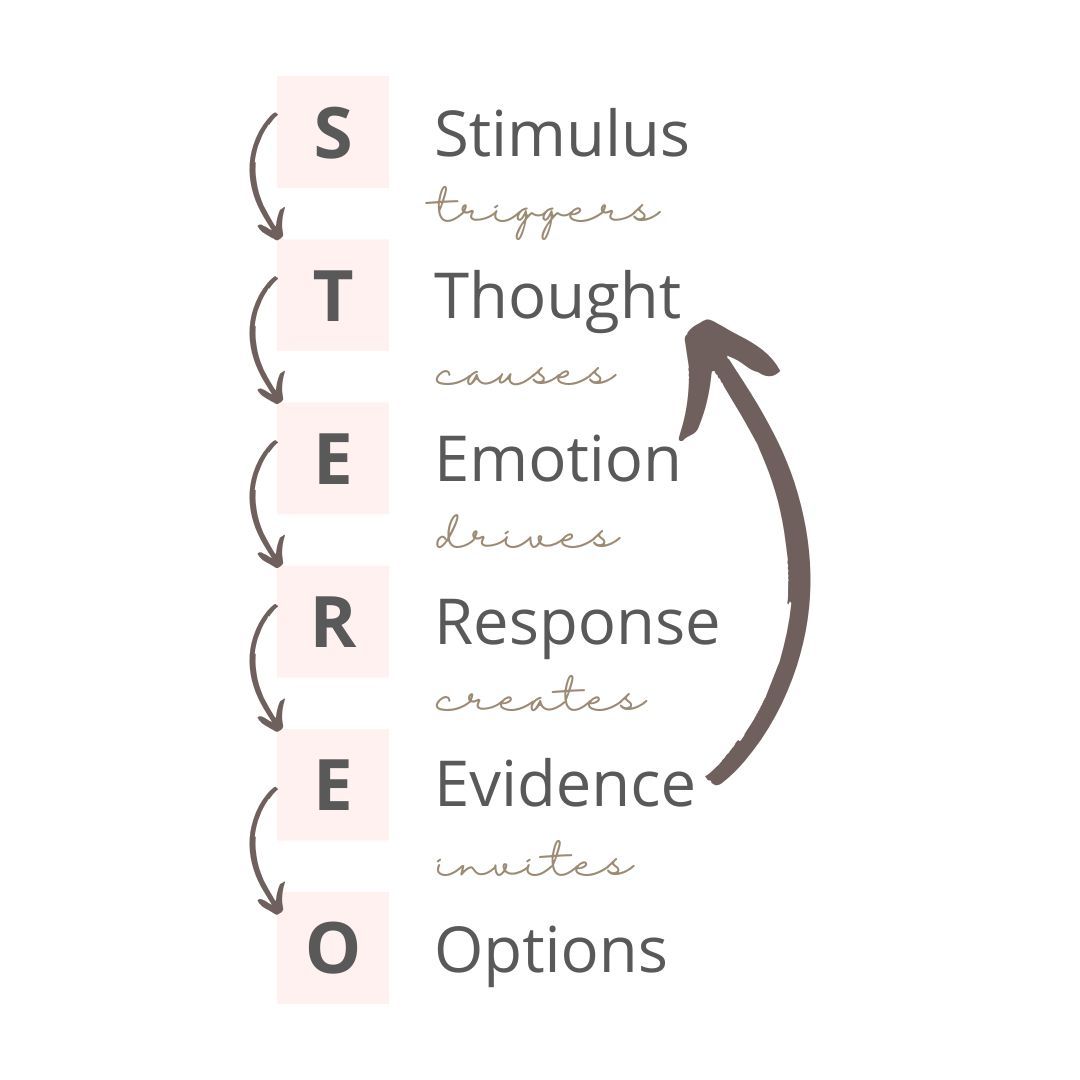
It’s the self-reinforcing loop:
- What you think causes how you feel.
- What you feel drives what you do.
- What you do creates evidence for your thought.
- So the same thought comes back, stronger.
That means, you often don’t just think something once.
You keep thinking it because you collected evidence for it.
What started as a thought has now become a belief and 'the truth'. A belief is a thought you have evidence for. You’re no longer just thinking the thought, you’re believing it to be true.
And that's why the pattern repeats.
❝We cannot choose our external circumstances, but we can always choose how we respond to them.”❞
Epictetus
(c. 50 – c. 135 AD)
❝Between stimulus and response there is a space.
In that space is our power to choose our response.
In our response lies our growth and our freedom.❞
Victor E. Frankl
(1905 - 1997)
The STEREO Map helps you become aware of the space between stimulus and response
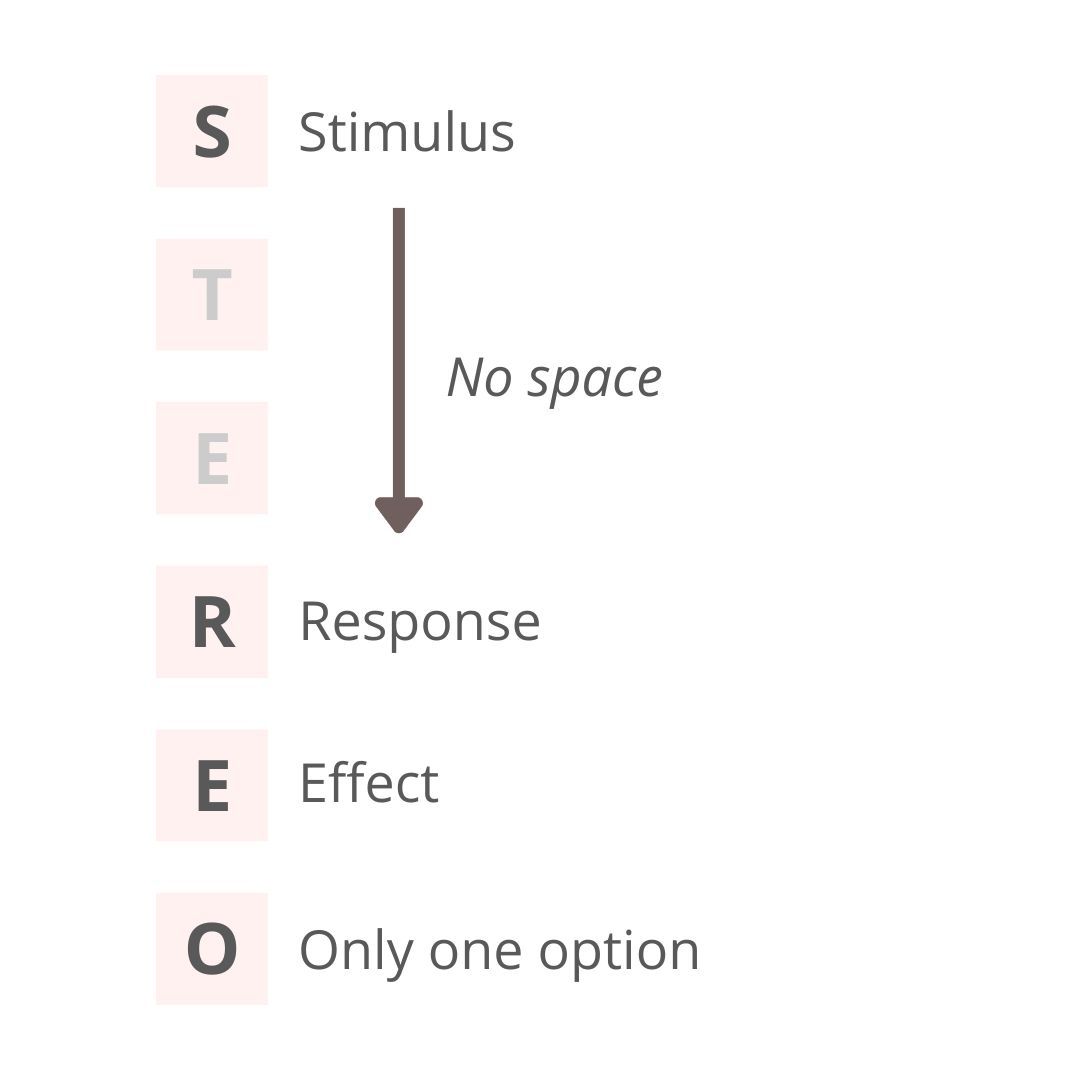
Without awareness
On autopilot and no space
When there's no space, the process often feels instant and fast.
You don't notice the thought (T) and emotion (first E) because they're programmed and conditioned.
You react (R) automatically, based on habit and past experience.
There is no pause. No awareness. No choice.
That’s why the same patterns repeat:
- If you think what you always thought,
- you'll feel what you always felt,
- and do what you always did,
- so you get what you always got.
What thought you here won't think you there.
With awareness
Space and making conscious choices
Change happens between the S and the R.
Between what happens and how you respond, there is a space.
In that space, you can observe your thinking.
And in that space you can choose other options (O).
That changes what you feel and how you show up.
This is how you break the pattern:
- If you change the way you think,
- it will change how you feel,
- which will change what you do,
- and that will change what you get.
Change your thoughts, change your life.
From obstacle to opportunity
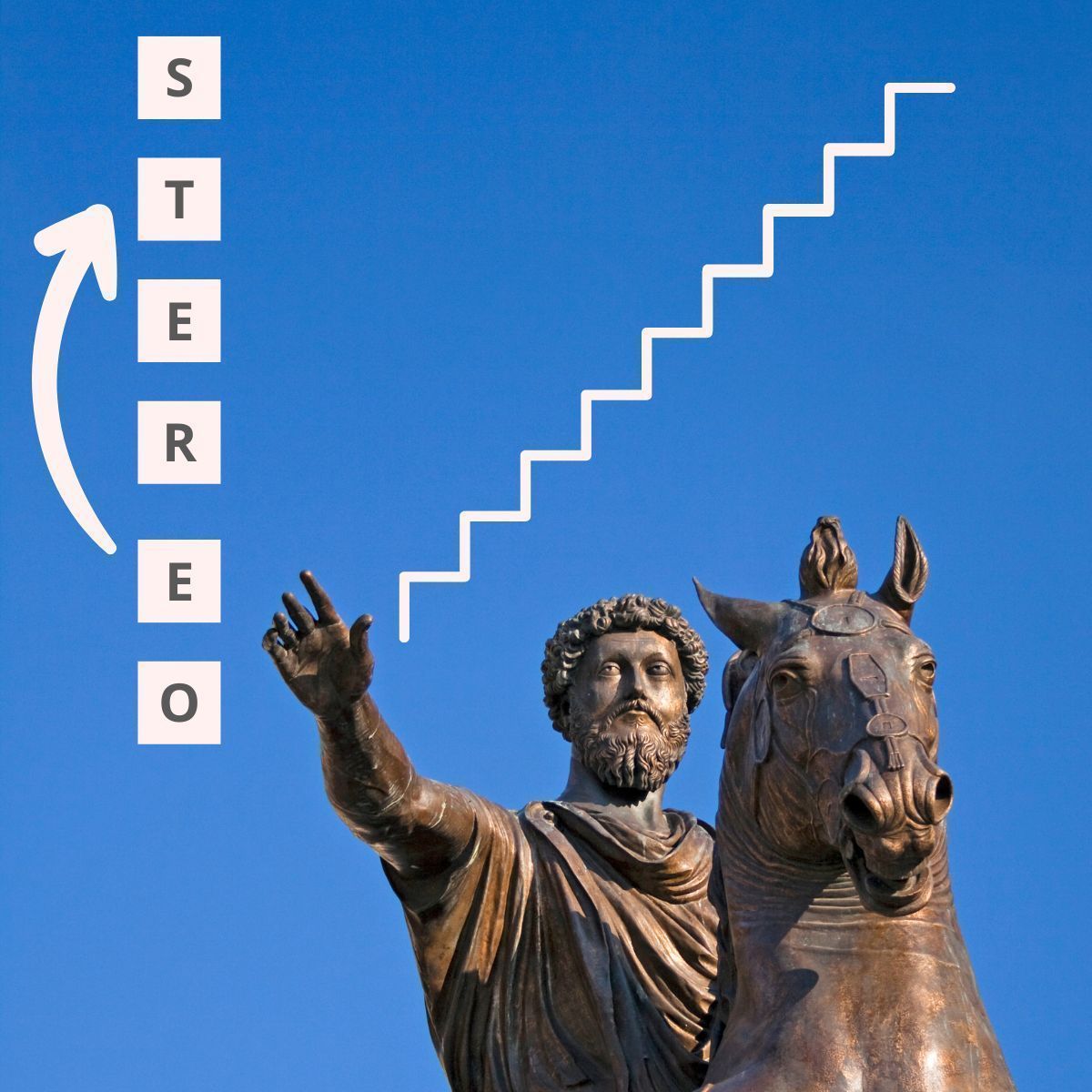
From S to O
Every situation can be experienced in different ways:
- Every situation starts as a stimulus. Something happens. There's an obstacle on the road. The situation is factual. It's neither negative or positive, until we make it mean something negative or positive.
- We have the tendency to label an obstacle as negative, and then we start to experience the obstacle as a problem. But the obstacle is not the problem. The problem is seeing it from only one perspective.
When you move through the full STEREO process, something changes:
- You see what you make a situation mean: someting bad, wrong or negative.
- You see how that negative thought creates a negative emotion.
- You see how that negative thought and negative feeling drives your behavior.
- You understand the pattern behind the reaction.
- You create space between stimulus and response.
- And from that space, new options become visible.
The situation doesn't change, but your perspective does.
That is where an obstacle becomes an opportunity for reclaiming your power of choice.
What you can control
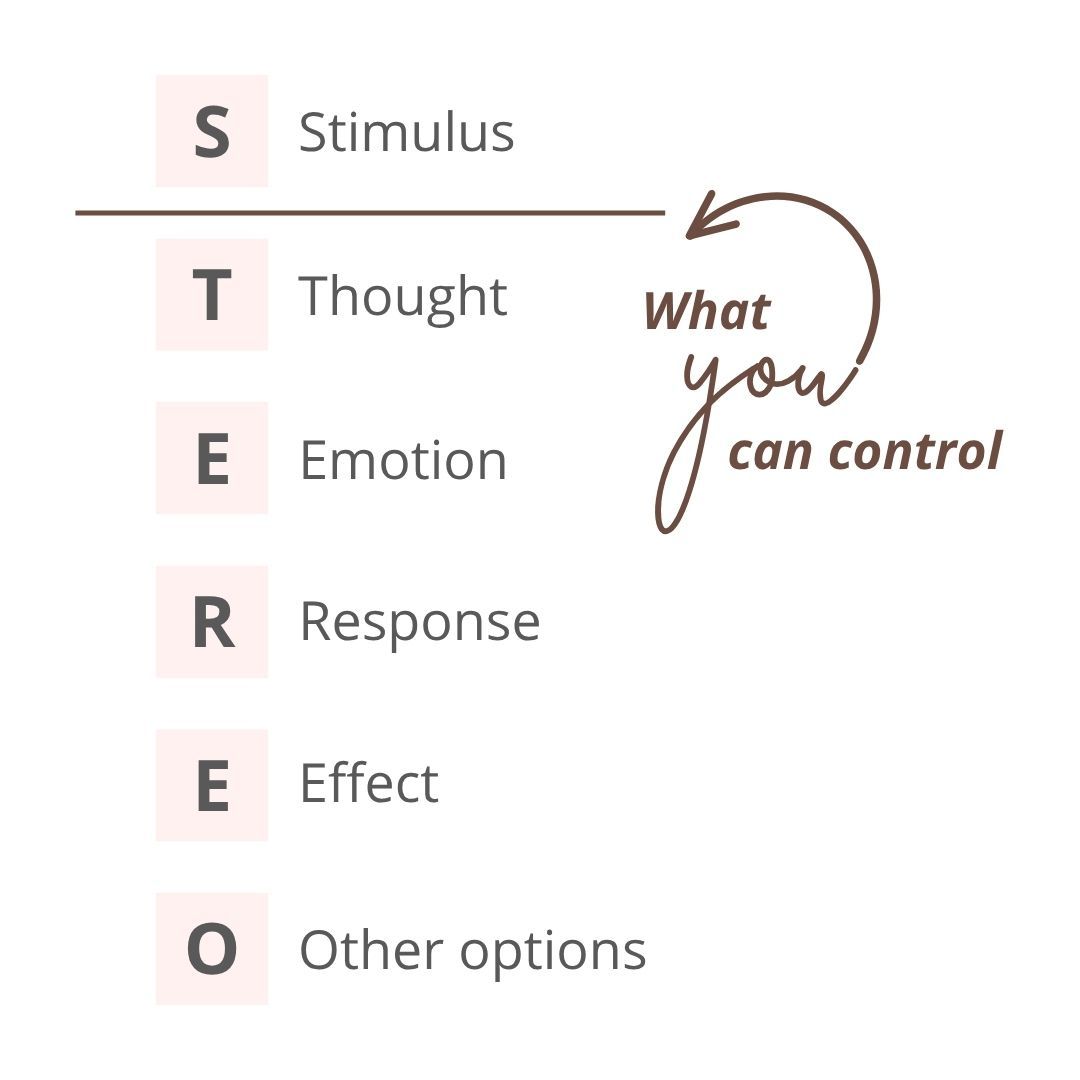
You can't control the stimulus.
But you can learn to control:
- what you think
- how you feel
- what you do and not do
- what you create
- your options
This isn't about control as in forcing or fixing. It's about expanding your thinking and seeing more than one perspective.
That's how you reclaim your power of choice.
❝If you are distressed by anything external, the pain is not due to the thing itself, but to your estimate of it; and this you have the power to revoke at any moment❞
Marcus Aurelius
(121 – 180)
What changes when you use the STEREO map
Before
❌ S: You see the situation as an obstacle.
❌ T: You focus on what's wrong.
❌ E: You feel disempowered.
❌ R: You react automatically.
❌ E: You stay stuck in the same patterns.
❌ O: You make a choice out of fear.
After
✔ S: You see the situation as an opportunity.
✔ T: You see more than one perspective.
✔ E: You feel empowered, no matter what.
✔ R: You respond in an helpful, useful way.
✔ E: You create growth and freedom.
✔ O: You make choices from desire.
Same situation. Different experience.
Most people don’t choose their experience. They react to it.
STEREO Coaching helps you rebalance that.
Self-Mastery
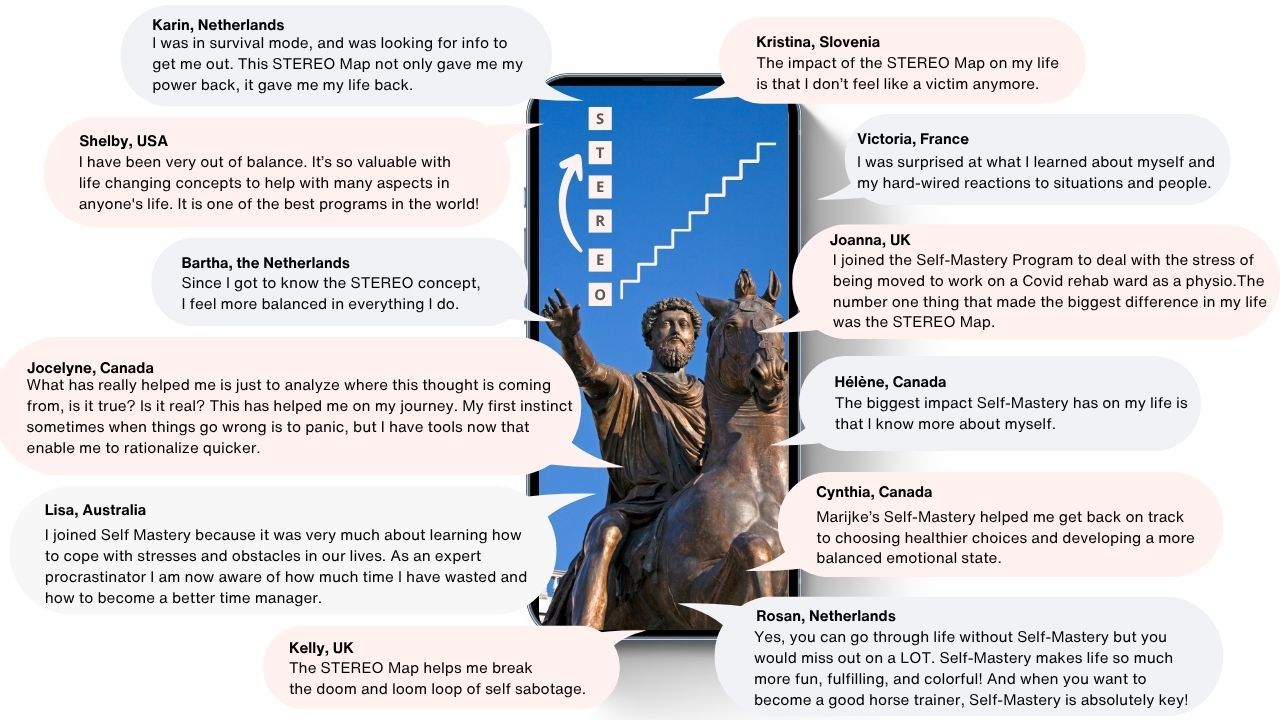
The STEREO Map is the tool for awareness developed by Marijke de Jong.
It's the foundation we use in STEREO Coaching.
It's simple to understand and you can use it for self-coaching and self-mastery.
Applying it in real situations requires awareness and practice.
That's where our Self-Mastery Program can support you so you can see clearly and respond differently.
FAQ
1. What is the STEREO Map and how does it work?
2. Who is the STEREO Map for?
3. When do I need to use the STEREO Map?
4. What if the situation really IS the problem?
5. How often should I use the STEREO Map?
6. How long does it take to see a difference?
7. Is this positive thinking?
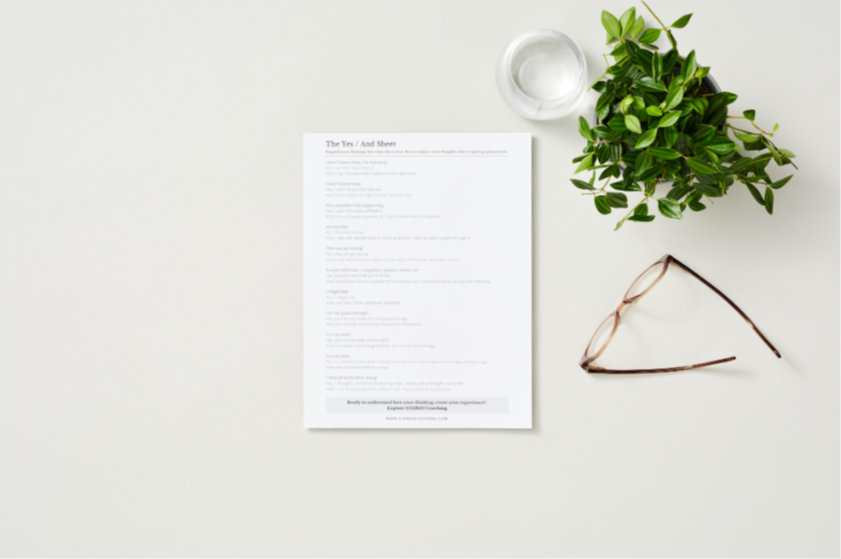
The Yes / And Sheet
For riders, instructors, coaches, teachers, and anyone who find themselves overthinking, overdoing, or going in circles.
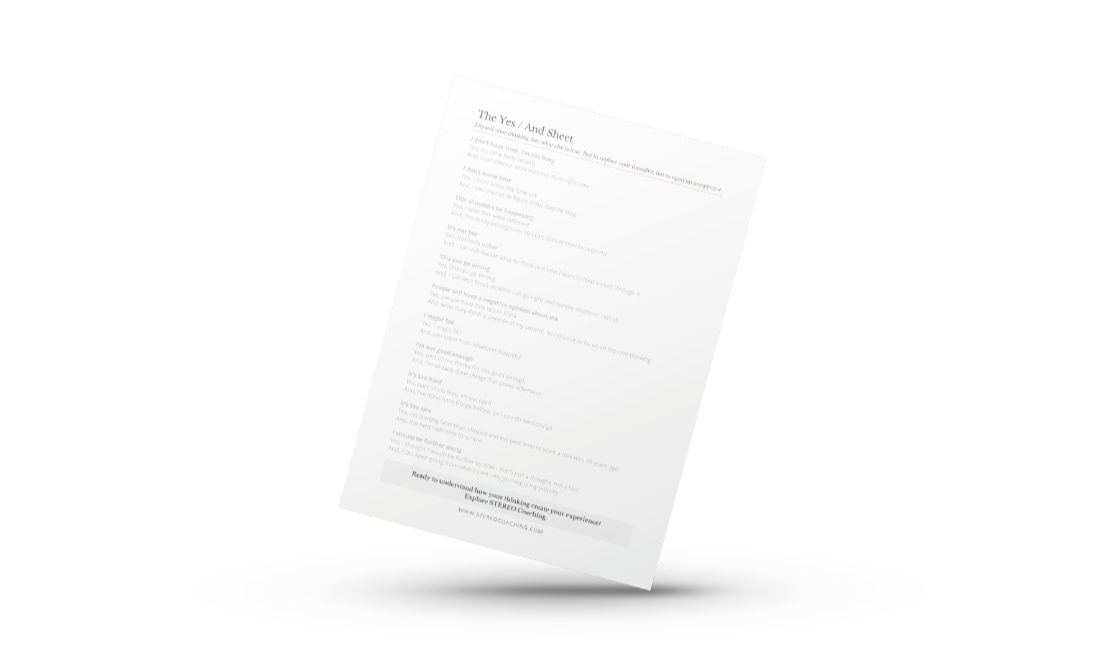
Expand Your Thinking
Discover the 10 most common thoughts that keep most people stuck – and what is also true.
Not to change your thoughts,
but to balance and expand them.
ABOUT MARIJKE
STEREO Coaching is developed by Marijke de Jong. After decades of coaching riders, instructors, and professionals worldwide she knows how to help people break free from what keeps them stuck.
PRIVATE COACHING
For those who are ready to stop abandoning themselves and start living in alignment. It's a space to let go of old patterns and return to your true self. Work directly with Marijke.
Limited availability. Not for everyone.